Pierre Hermé: The “King of Modern Patisserie”
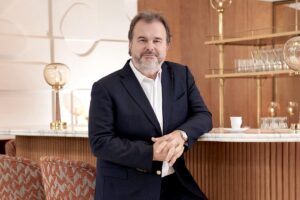
Pierre Hermé is often referred to as the “Picasso of Pastry” and the “King of Modern Patisserie,” who is world renowned for his unique, refined creations. He was the youngest chef to be awarded France’s Pastry Chef of the Year in 1997 and since then has built an empire. After opening his first signature shop Maison Pierre Hermé in 1998 in Paris, he has expanded his reach throughout Europe, Asia and the Middle East. His macarons, chocolates and other pastries have put him at the forefront in the food world, and he was voted the World’s Best Pastry Chef in 2016 by the World’s 50 Best Restaurants.
Recently, a lucky selection of Valrhona Cercle V members along with the semi-finalists in the North American Regional C3 Competition were invited to an intimate gathering with Hermé at L’Avenue at Saks Fifth Avenue in New York. Guests were offered a selection of his famous creations while Hermé discussed his first shop within the United States, how he stays creative, and his thoughts on current industry trends.
What is your process for creating new recipes or products?
One thing that has not changed for me over the past 30-40 years is my way of working. That is, I start off with an idea, ingredient, or emotion, and I compose something in my head. Then I transpose that on paper, and by that, I mean a recipe. And that is turned into a sketch, because I want to see the proportions and what the architecture of the flavors can be. I’ve been doing that since 1983; that has never changed.
At Maison Pierre Hermé, the creative workshop is a completely different business compared to the rest of the business. We have three talented people working full time on the elaboration of new concepts and recipes—with their own interpretations—based on ideas I give them. [For example], say I’m working with a ganache, and I want to replace some ingredients. Well, I bounce ideas off them, they give me their point of view, and based on that, they’re able to build on my initial suggestion.
 What is very important in this kind of creative work is that we don’t pose any limits at the start. Because if one approaches this process in a rational way, then one ends up needing to resort to compromises, and compromises are never good. In the creation stage, we need to keep all of our options open. After that is done, then we include all of the rational elements in a workable system. If we started the other way around, that is, if we took into consideration all the rational components first, then we would be cutting out options and possibilities.
Then, when I have gotten to the stage where I validated a recipe, there’s the writing stage. When the recipe is written, it’s written down gesture-by-gesture in a very precise way. We even include the weight for each ingredient in the recipe. After that is done, the recipe has to face reality. The pastry chefs that work in the Atelier de Création then work side-by-side with the production department. I have a person, Michael, who goes into the field and acquires all the information on the practical components of the recipes and notes changes that are required. He updates the recipe and then shares it with everybody. [After that], we have a database, which is shared with all the chefs, and there are figures for labor costs and ingredient costs that are points of reference to be adapted locally.
When you are creating something with chocolate, what is your process? Is it more about the flavor, or perhaps the location of origin?
For a few years, I’ve been working closely with Valrhona, and I have the privilege of having a point of contact that I bounce ideas off of. There are agronomists that work at Valrhona, and we talk about the cocoa beans in terms of quality. So, we work with cocoa beans originally identified by Valrhona and discussed with us, and then, we define the percentage of cocoa and sugar that is added in a specific way. We’ve come up with a number of single-origin lines from [places like] Brazil, Belize, Madagascar and Peru. We also have a milk chocolate variety that we haven’t been able to import yet, but we shouldn’t be far from it now. [This process], allows us to work with chocolates that have a very specific and clearly identifiable taste, which helps us differentiate from others.
You’ve talked about using less fat and less sugar in your products in the future. Are there other ingredients you tend to shy away from or eliminate from your products?
In terms of a sugar reduction, that’s something I’ve been working on for a long time. For less fat, I want to make products that are less calorie-filled.
Eliminating – not quite. However, I do like substituting ingredients. In some cases, I like working with an ingredient until the very end and exploring all of its possibilities. I can’t say that I wouldn’t use a specific ingredient, but there are some ingredients—thyme or rosemary—that I don’t particularly like, and therefore tend not to use. Having said that, I did do a macaron recently with wild thyme from Corsica that I paired with lemon, and it did work quite well. Sage is another herb that I don’t particularly like, but I used it for a Christmas Buche log with other components, and together, the elements worked extremely well.
Nguồn: https://pastryartsmag.com/people/pierre-herme/